
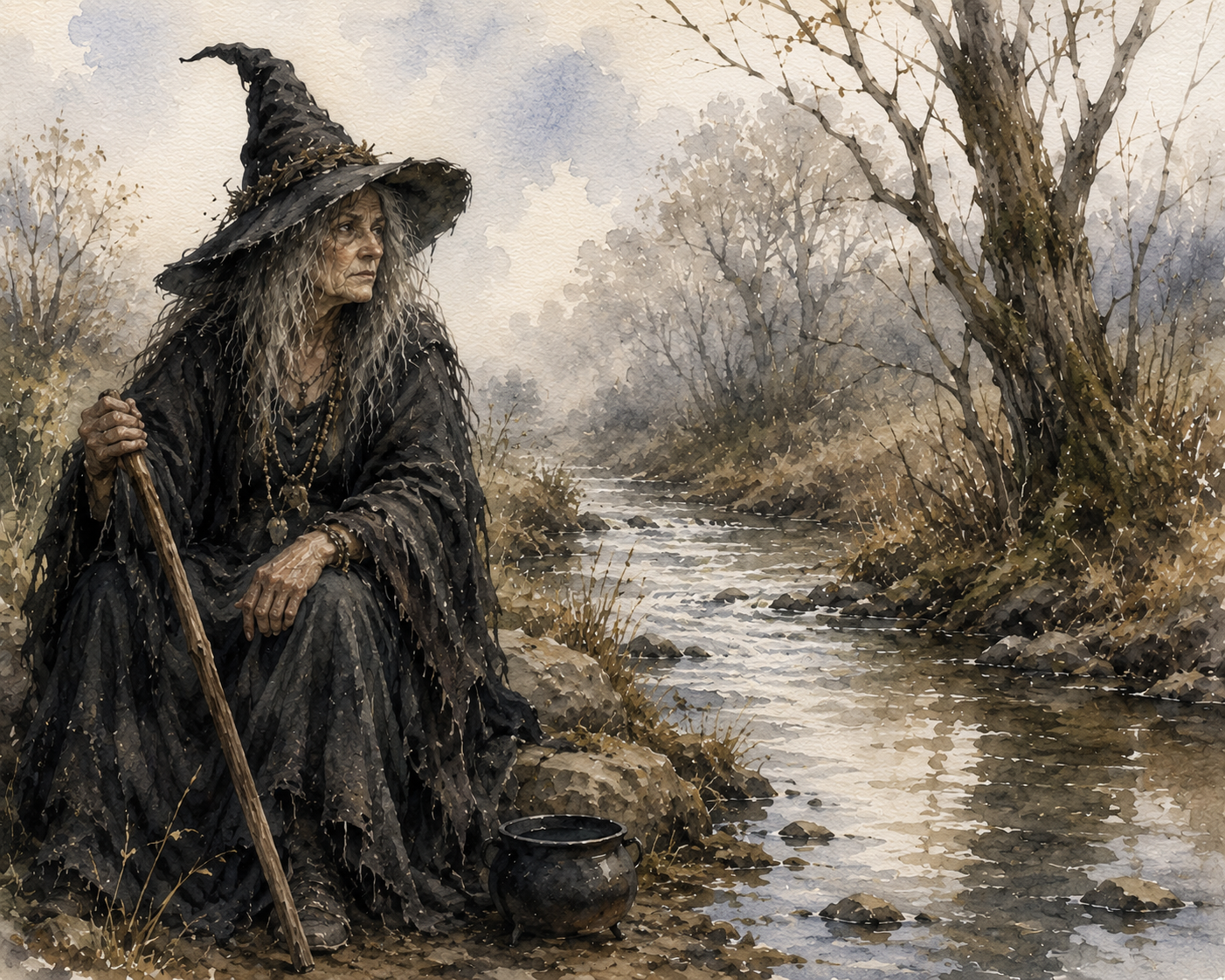
Esperance is an old township in Schoharie County, upstate New York, with a local legend about a witch. I was asked to investigate the origins of the story and discover who this mysterious woman might actually have been, as her name is never mentioned. What I uncovered was far less a tale of witchcraft and far more a story of land and power. At its heart may have been a land grab, and a woman who, perhaps driven to desperation or even madness, watched as the local creek she cared about was slowly ruined.
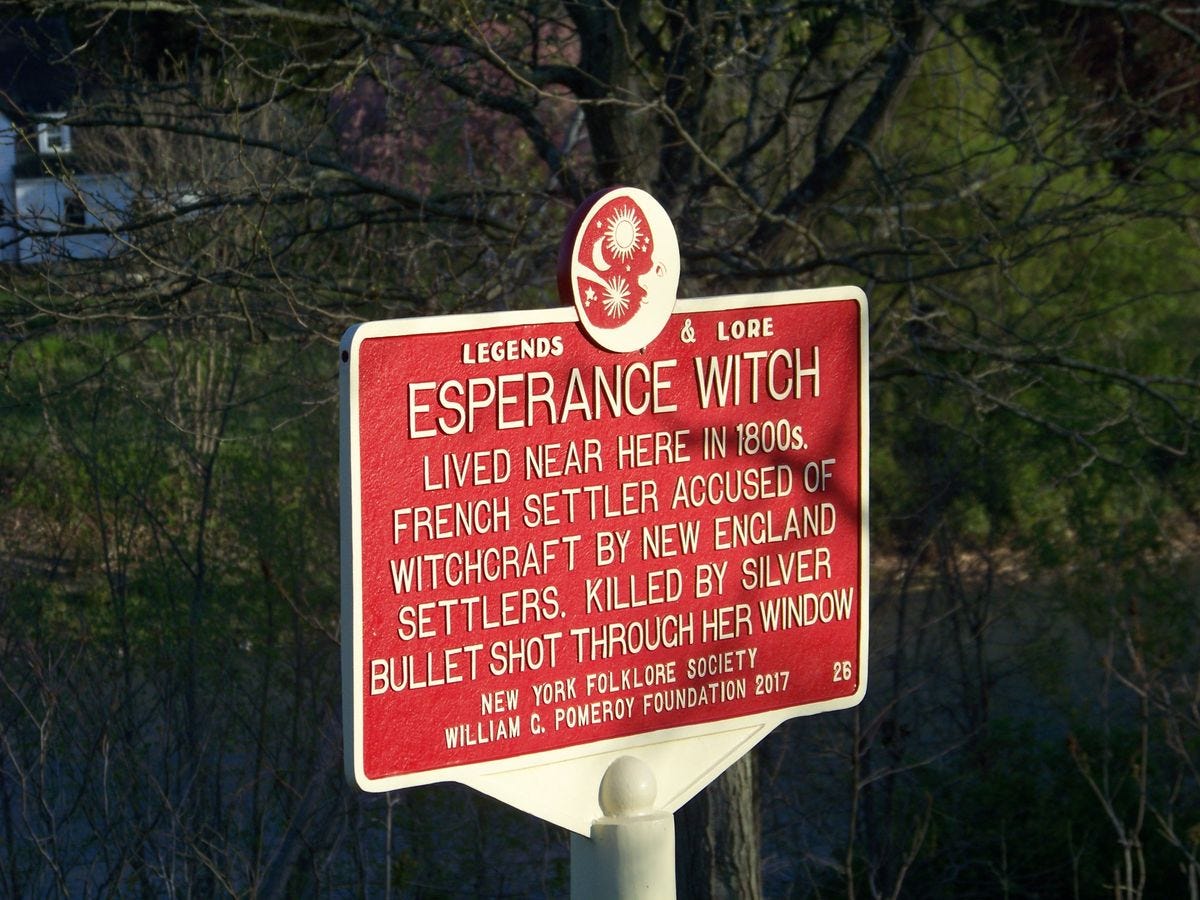
The traditional story tells of a French woman who settled with her husband and children across the creek from Esperance. After her husband died, she lived alone, supporting her children in her frugal and isolated way. Unable to speak English and regarded as mysterious by the local community, she soon became the subject of gossip and was branded a witch.
Stories claimed she could cross the creek by laying her apron on the water and using it as a boat, while other misfortunes, including sick children, dying cattle, sour milk, a storm, and the death of a man injured while hauling a log, were blamed on her.
Eventually, the townspeople supposedly met to decide her fate. A silver bullet was made from a spoon by local silversmith Storrs Messinger, and the men went to the woman’s home and shot her through the window. Some accounts mention this happened in front of her children who were playing on the floor. According to different versions, she was then buried with a stake through her heart, either across the creek to prevent her spirit from returning, or beneath trees whose roots would keep her from rising.
The story was passed down through generations, seemingly originating with Storrs Messinger himself. A 1912 account in the Cambridge Sentinel describes her as the ‘Grenadiers Widow’.
The Truth
One of the earliest settlers was a Frenchman, Jean Grantier, who purchased land on the opposite side of the creek to Esperance. Jean Grantier was sometimes referred to as John Granadere or Grenadier, he married Elisabeth Kniskern from German palatine descent.
During the 1780’s the old settlers brought land in the area. They were invited by General William North to invest. After the revolutionary war it became increasingly hard to buy land in the area. John Grantiere, was an old recruit of William North, he settled near the bridge with 100 acres, in Schenectady County. Around 1803 he passed away. His wife Elisabeth inherited the land and property in his Will.
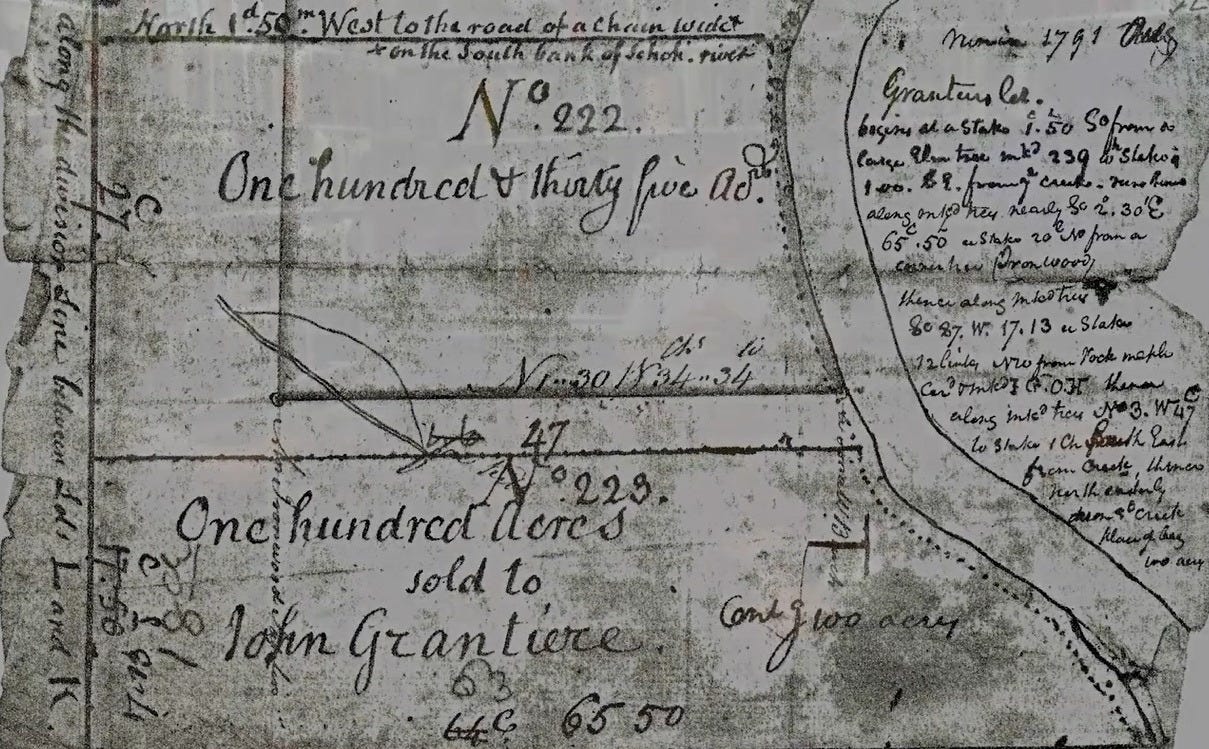
A temporary bridge was constructed over the creek, connecting Esperance and Schenectady County in 1799. The present one was not started until 1809, one Burr, took the contract to build a new bridge and built the abutments a few feet high when he was called to some other place to construct a bridge, and did not return till the year 1811. The structure was finished in 1812.
Elisabeth Kniskern died in 1809 buried at the Old Stone Fort cemetery (a witch would not be buried there), when she was 63 years old, exactly at the time of the new bridge contract. Elisabeth’s son Henry inherited the land & property, and interestingly he started selling it off in 1811. The same time Burr returned to complete the bridge.
The Will went on to say: ‘Give to my son Henry, upon my wife’s decease or re-marriage, all my estate both real & personal excepting the house wherein John Ford & James Clement now lives on the South side of the Turnpike Road together with the piece of land annexed to the same previously occupied by Nathianel Tollman.’
The Turnpike road led across the bridge. In 1811 an Inn, the Phoenix, was built next to the bridge. It was for many years kept by Tollman. In the last days of its usefulness as an Inn, landlords loved to tell the traveller of the hideous “spooks” and unearthly noises that were seen and heard nightly within its walls.
It all shows how important that land was next to the creek and bridge. And the activity that surfaced after John Grantiere and his wife passed away.
Back to the silversmith; Storrs Messinger, who was at the most 15 years old when Elizabeth died. Daniel Beach was the first jeweller in Esperance and left in 1818 and was familiarly known as “Tinker Beach.” He was succeeded by Storrs Messenger who came from Connecticut in 1817. It’s possible Storrs was under apprenticeship in 1809, and helped make the bullets. However it appears he arrived much later.
One of the earliest versions of the story back in 1845 names a man called Rector as the man who shot the witch, not Storrs Messinger. The only man I could find of that name was Rector McKenzie, who lived in almshouses, meaning he was quite poor and relied on charity. Quite easily could be paid to shoot the witch, but that’s pure speculation, and who’s to say it was him.
There were two connections to Messinger: Storrs Messinger & his wife’s family Delavergne, after the death of Elisabeth they owned the land North of the creek, directly opposite to the old Grantiere property. And, Storrs Messinger’s grandmother Kathlrine Brown may have been related to James Brown who bought property from Henry Grantiere in 1812.
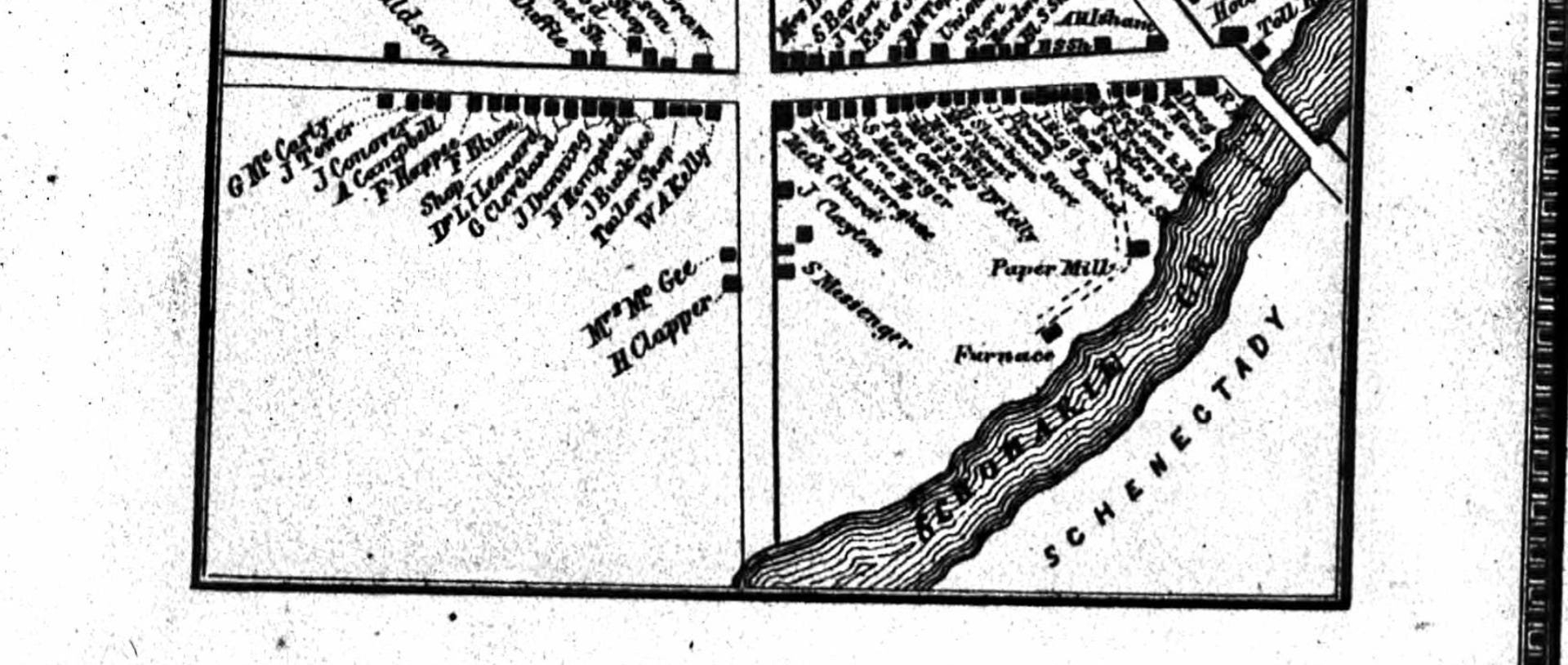
Additionally the creek, once a clear and useful source of water, probably became polluted by the industries that grew along its banks, a silversmith needed water. The dye works, tanning & milling flowed into the water, likely turning it foul and unusable. For local residents, this was not merely an environmental nuisance, but a direct threat to everyday life. Enough to cause ill feelings. The story of the witch with the apron, could simply be Elisabeth trying to wash clothes in the creek.
The story of the witch was passed down from generation to generation. The source of the story appears to have been Storrs Messinger himself and he lived to be past 90 years of age. His grandson, Storrs Seeley, remembered his grandfather telling him the story. It became legendary.
Another part to the story is Elisabeth was from German Palatine descent, her father was born about 1717 in the New York colony. Initially during early settlement the wealthy Dutch and English settlers used the Germans for forced labour, calling them “hewers of wood and drawers of water”. They were treated unfavourably as an immigrant group rather than settlers. Over time the Germans became assimilated into the broader American fabric, fighting in the American Revolution and speaking English. It’s interesting the story of the witch highlights that she did not speak English.
During these times, even into the 1800’s superstitions flourished. The region had been inhabited by Indigenous peoples, after which Christian European settlers arrived. African Americans, including enslaved people, were also part of the wider colonial population, and each community carried its own superstitions. Haunted hollows, ghosts and witches. Some very similar stories of silver bullets and innocent children. The innocence of children normally used to make the story even more macabre.
One thing I am sure of is that Storrs Messinger told a very tall tale, which created tourism in the town, and it still does today. There appears to be a reluctance to tell the whole story, the true story. Perhaps because it’s not as mysterious and it’s not the story that was told for the last 200 years – and certainly by this time it’s become entrenched into the culture and fabric of the town.
A folk song about the Witch of Esperance:
Leave a Reply